
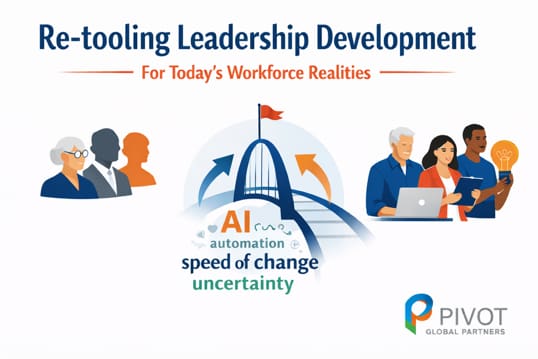
Retooling Traditional Leadership Development for Today’s Workforce Realities
03/10/2026
Author: Jaye Smith |
Pivot Global Partners, Senior Consultant & Advisor |
Serial Entrepreneur & Author | Leadership Development & Training Expert |
(Crossing Meridians® Leadership Insights)
What’s old is new again.
We’re entering a new chapter of leadership, regardless of how long you have been leading others. Some new rules apply, and perhaps, more importantly, some old ones deserve renewed attention.
Today’s leaders are navigating a workplace unlike any we’ve experienced before.
Consider the environment around us:
- Rapid technological change
- Accelerated use of AI and automation
- Five generations working side by side
- A constant stream of information from social media
- Global political and economic uncertainty
Employees, leaders, and customers alike are all absorbing this noise every single day.
Let’s pause for a moment. Is change new? Not at all. Leaders have always had to navigate change and often large amounts of it.
What is different today is the pace of change and the uncertainty around how these forces will impact business strategy, workforce expectations, and organizational success.
The velocity is faster than ever. And many employees feel overwhelmed by pressures they cannot control. That responsibility falls to leadership.
Crossing Your Own Leadership Meridians
In our Crossing Meridian’s 2.0 model, leadership is about more than guiding a team forward. It’s about leaders crossing their own meridians—moving into the next phase of their own development while helping others move into theirs.
The concept of “crossing over” isn’t new in leadership development. But what that crossing means today—and what you choose to create on the other side—is evolving rapidly.
Leadership today requires:
- Nimbleness
- Flexibility
- Curiosity
- Continuous learning
Leaders must remain open to new ideas and rapidly develop a working understanding of technologies like AI. More importantly, they must surround themselves with people who can teach them what they don’t yet know.
This has always been true to some degree, but today’s environment demands it more than ever.
We’re learning as we go, experimenting with new approaches, new tools, and new ways of communicating, collaborating, and measuring success. That raises the question: What leadership practices still hold true in times like these?
The Leadership Principles That Still Matter
When we step back, many of the most effective leadership tools are not new at all. They have simply become more important.
The fundamentals still matter:
- Creating a positive culture
- Establishing clear priorities
- Listening to what employees think, need, and feel
- Practicing open communication
- Developing self-awareness
- Soliciting and giving meaningful feedback
- Thinking strategically
- Leading with transparency
These principles have always formed the foundation of strong leadership. What’s different now is the intentionality required to practice them consistently.
Today’s workforce expects clarity, authenticity, and connection. Employees want to understand not just what they’re doing, but why their work matters. That is where leadership makes the greatest difference.
Leadership Call to Action
So, what can leaders do right now to retool themselves and build more resilient teams?
Start here:
1. Communicate strategy clearly and often
Your team should understand where the organization is going and why it matters.
2. Clarify roles and expectations
People perform better when they understand how their work contributes to the larger mission.
3. Ask hard questions
Challenge assumptions—your own and your team’s.
4. Hold the team accountable
Accountability raises expectations and empowers people to reach them.
5. Prioritize employee well-being
Resilient teams require leaders who recognize what people need to thrive.
6. Invest in continuous learning
Encourage curiosity around technology, innovation, and new ways of working.
7. Create space for honest dialogue
Great ideas and solutions often emerge from open conversations.
8. Model adaptability
Your team will mirror the mindset you demonstrate.
The Leadership Imperative
Leadership has always been about guiding people through uncertainty. What has changed is the speed, scale, and complexity of that uncertainty.
The essence of leadership, however, remains the same. People still want clarity. They still want to be heard. They still want purpose in their work. And they still look to leaders to help them navigate what comes next.
As leaders cross their own meridians of growth, they have an opportunity to amplify the best of traditional leadership while re-tooling for today’s workforce realities.
Change will continue. Ask yourself: How will you lead through it?
I’m curious to hear from other leaders: What leadership skill do you believe is most critical to develop right now?
Let’s continue the conversation.