
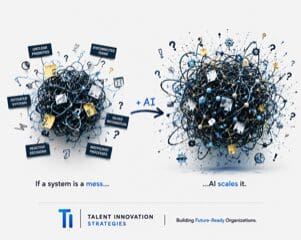
AI Transformation: Are You Scaling Capabilities or Dysfunction with AI?
Author: Dr. Henry Huang
Founder, Talent Innovation Strategies | Human Capability & Organizational Transformation Strategist | Harvard Business Review Advisory Council Member | Collaborator, Pivot Global Partners
Message from Pivot Global Partners:
This blog is the first in a two-part contribution from Dr. Henry Huang. The second blog will be published in August 2026.
(Crossing Meridians ®Leadership Insights)
Organizations are investing millions into artificial intelligence (AI) with the expectation that productivity, innovation, and performance will improve.
Yet many are discovering a surprising reality: despite more automation, more output, and more data, they’re not necessarily making better decisions, executing strategy more effectively, or achieving better business outcomes.
The reason is simple. AI doesn’t fix broken ways of working. It scales them.
In many ways, we’ve seen this before. Periods of disruption have a way of exposing strengths and weaknesses that may have remained hidden during more stable times.
COVID exposed weaknesses that had existed inside organizations for years—unclear decision-making, rigid operating models, weak leadership pipelines, limited adaptability, and cultures that struggled to respond to disruption.
Economic uncertainty exposes weaknesses in the face of slowing demand, lagging development of customer insights, and an inability to reposition the organization during challenge.
AI is doing the same now.
AI doesn’t create clarity, adaptability, judgment, or resilience. It reveals whether those capabilities already exist.
Whether you lead a team of five, a division of fifty thousand, or are navigating a career transition of your own, the question is the same: What are you actually scaling?
The issue isn’t the technology. The issue is what the technology is amplifying.
The Human Capability System™
What AI ultimately exposes is the strength—or weakness—of what I call the Human Capability System™: the interconnected system of strategy, leadership, decision-making, culture, operating models, and workforce capability that determines whether an organization and its leaders can adapt, innovate, and execute in a rapidly changing environment.
Organizations often treat AI as a technology initiative. In reality, AI is a capability amplifier. It magnifies the strengths and weaknesses already present in the organization and the leader.
- When strategic priorities are clear, leaders are aligned, decision-making is sound, and employees are empowered to think critically, AI accelerates performance.
- When those conditions are absent, AI accelerates confusion, inefficiency, and poor decisions just as efficiently.
AI Accelerates What’s Already There
Think of AI as a multiplier. It takes what already exists—in your organization and in you—and scales it faster, farther, and with greater force.
- Where strategy is clear and systems are aligned, AI amplifies performance.
- Where priorities are unclear and accountability is weak, AI amplifies dysfunction.
Consider what happens when the conditions for effective performance are absent:
- If an organization rewards speed over thoughtful decision-making, AI increases output but not judgment.
- If employees hesitate to challenge assumptions or surface risks, AI accelerates decisions while leaving blind spots unaddressed.
- If organizations lack mechanisms for reflection and learning, AI helps teams execute faster without improving effectiveness.
I saw this pattern play out firsthand in a large organization navigating a major strategic shift. AI-powered dashboards surfaced information faster than leaders had ever seen. Yet because priorities were unclear and strategic goals weren’t aligned, the technology generated more discussion than action. The technology worked. The system surrounding it didn’t. That distinction matters.
Research consistently points in the same direction. BCG has found that approximately 70% of AI implementation challenges relate to people and processes rather than technology. MIT Sloan Management Review similarly has found that AI creates the greatest impact when organizations redesign workflows and decision-making systems—not when they simply automate existing tasks. Yet most organizations are still leading with the tech stack.
Seven Questions Every Leader Should Ask Before Scaling AI
Whether you are leading an organization or leading yourself through a period of change, consider these questions:
1. What are we actually scaling?
What strengths, habits, blind spots, or organizational realities will AI make more visible and more consequential?
2. Is direction clear, aligned, and actively shaping how work gets done?
Is strategy genuinely shared at every level where decisions get made—or just documented in a plan?
3. Are current ways of working designed for the realities of today?
Before automating a process, ask whether it is still the right process. Accelerating what is broken rarely creates transformation.
4. Are the right capabilities in place?
Do your people have the strategic thinking, judgment, adaptability, and entrepreneurial thinking AI cannot replace? Are you investing in those same capabilities in yourself?
5. Are the conditions for high-quality thinking and performance in place?
Psychological safety, strategic clarity, and space for reflection and experimentation aren’t optional. They’re the infrastructure that determines whether AI creates value for your organization and for your own leadership.
6. How will success be measured beyond efficiency?
AI adoption should be measured by the quality of decisions made, the clarity of direction, and the degree to which it is creating capacity for better thinking and genuine innovation—not just more output.
7. Are we adding the perspectives our future requires or simply adding more of the same?
The next time you make a hiring or promotion decision, don’t just ask: “Have they done this before?” Ask: “Do they see something the rest of us don’t? Do they bring the curiosity, creativity, and courage to build something better?”
The answers to these questions reveal far more about future readiness than any technology roadmap. But reflection alone isn’t enough. Start with one honest conversation—with your leadership team, or with yourself.
Ask: If AI amplifies what already exists, what is it amplifying in us? The answer—honestly confronted—is your roadmap.
Most leaders skip that conversation entirely. The ones who don’t are the ones who pull ahead.
The Bottom Line
AI doesn’t create organizational capability. It reveals and scales whatever capability, clarity, and strength already exist.
The organizations that thrive in the years ahead will cultivate leaders who create clarity, employees who think entrepreneurially, teams that continuously learn, and cultures that encourage experimentation and innovation.
The future belongs to organizations that cultivate the perspectives required to see opportunities others miss. Technology will continue to evolve. The real question is whether organizations and the leaders within them will evolve with it.
That means you need to examine whether you’re building the clarity, capability, judgment, and adaptability worth scaling.
As you look at your leadership agenda, talent strategy, and your own development for the coming year, ask yourself:
What is the first pivot you need to make to ensure you’re scaling capability rather than dysfunction?
I’m proud to partner with Pivot Global Partners to guide you through this assessment and solve your unique challenges.
Contact me at henry.f.huang@gmail.com or Pivot Global Partners at hello@pivotglobal.com to explore how we can work together.
AI Transformation: How to Recognize and Solve for the Gaps
August 5, 2026
Author: Dr. Henry Huang
Founder, Talent Innovation Strategies | Human Capability & Organizational Transformation Strategist | Harvard Business Review Advisory Council Member | Collaborator, Pivot Global Partners
Message from Pivot Global Partners:
This blog is the second in a two-part contribution from Dr. Henry Huang.
(Crossing Meridians ®Leadership Insights)
In Part I of this series, I focused on how AI amplifies and scales capabilities that already exist in an organization—whether stellar, mediocre, or woefully lacking.
In this post, I delve into the most prevalent gaps that impede AI transformation and offer practical guidance to address them.
My primary observation is that the organizations and leaders that pull ahead won’t be those that deployed AI fastest. Instead, they’ll be those that honestly confronted their gaps and closed them.
Three gaps, in particular, determine whether AI becomes a genuine force multiplier or simply a faster way of magnifying existing problems.
1. The Perspective Gap
One of the biggest challenges facing organizations today isn’t a technology gap. It’s a capability gap rooted in perspective.
For decades, many organizations have designed talent systems around functional expertise and prior experience. Those attributes remain important, but they increasingly aren’t sufficient on their own.
Future success increasingly depends on capabilities such as:
- Strategic thinking
- Problem solving
- Adaptability
- Learning agility
- Innovation and entrepreneurial thinking
- Business acumen
- Sound judgment
- Collaboration and influence
- The ability to connect seemingly unrelated ideas and perspectives
In environments defined by uncertainty and rapid change, the ability to learn faster than the environment changes may matter more than any single area of expertise. Organizations that hire and develop people primarily for what has been done before often struggle to create what has never existed. Leaders who rely too heavily on past experience often struggle to lead through conditions that have no precedent.
But building these capabilities requires more than training programs. It requires a fundamentally different approach to how organizations hire, promote, and reward talent.
Most organizations have spent years optimizing for functional expertise—hiring the same backgrounds, promoting the same profiles, and rewarding the same type of thinking. The result is that the most dangerous talent risk today isn’t a skills gap. It’s a perspective gap.
When everyone in the room shares similar experiences, assumptions, and ways of thinking, organizations develop a blind spot the size of the future. The challenges coming next won’t look like the ones that got you here. And the expertise that solved yesterday’s problems can sometimes blind us to tomorrow’s opportunities.
As AI becomes more capable of generating answers, competitive advantage increasingly shifts toward the quality of the questions being asked. Organizations that cultivate diverse perspectives and challenge assumptions are often better positioned to uncover opportunities that others never imagined.
The leaders who thrive will not necessarily be those who know the most. They will be those who can learn, adapt, and connect ideas faster than change unfolds around them.
Experience solves familiar problems. Perspective reveals new possibilities. AI doesn’t solve a perspective gap. It scales it.
The next time you make a hiring or promotion decision, don’t just ask: “Have they done this before?” Ask: “Do they see something the rest of us don’t? Do they bring the curiosity, creativity, and courage to build something better?”
2. The Strategy-Capability Gap
In addition to the perspective gap, a strategy-capability gap can impede or sub-optimize AI transformations significantly.
The organizations seeing the greatest returns from AI aren’t necessarily the ones deploying it first. They’re the ones asking a different question: Is our organization actually designed to take advantage of what AI can do?
Answering that question requires honest evaluation across four dimensions of the Human Capability System™:
Strategic Clarity
- AI cannot be a substitute for a clear strategy.
- Organizations that lack alignment around priorities find that AI accelerates confusion as much as progress.
- Leaders who lack clarity about their direction find AI amplifies their busyness, not their effectiveness.
- Strategic clarity isn’t just an organizational requirement. It’s a leadership one.
Human Capability
The organizations that benefit most from AI aren’t simply training employees to use new tools. They’re strengthening the capabilities AI can’t replace:
- Strategic thinking and critical reasoning
- Business acumen and sound judgment
- Adaptability and innovation
- Entrepreneurial thinking—not because every employee needs to start a business—but because future success depends on people who can proactively identify opportunities, challenge assumptions, and create value in uncertain environments
These are the capabilities that compound over time, determining whether AI amplifies your leadership or replaces it.
Operating Model and Decision-Making
- Many organizational processes were designed for a different era.
- Automating outdated workflows rarely improves them. Instead, it often makes them faster and harder to change.
- Transformation requires rethinking how work gets done, how information moves, who owns key decisions, and how the organization executes strategy at every level.
Psychological Safety and Culture
- In organizations where people don’t feel safe challenging assumptions or questioning AI-generated recommendations, flawed outputs go unquestioned.
- Organizations that reward compliance over candor don’t get bad AI outputs. They get unquestioned ones.
- And unquestioned outputs, executed at speed, are where the real damage happens.
- Psychological safety isn’t a cultural luxury. It’s a strategic necessity and the prerequisite on which entrepreneurial thinking and genuine decentralization depend.
Using the Human Capability System™ framework, you can make an honest assessment of your readiness to take advantage of the power of AI. Where you find strategy-capability gaps, focus on addressing root causes to ensure a solid foundation for transformation success.
3. The Transformation Gap
The organizations creating the greatest value from AI aren’t those deploying it fastest. They’re the ones willing to ask the harder question: How should we operate to win in this environment?
Automation asks: How can AI do this task faster?
Transformation asks: How should our business operate to win? What strategy are we executing, how does work need to flow to deliver it, what decisions need to be made and by whom, and where does AI fit in a way that strengthens rather than circumvents human judgment?
One focuses on efficiency. The other focuses on effectiveness. One optimizes existing systems. The other redesigns them.
Organizations focused solely on automation may begin to move faster, but in many cases, they simply reach their strategic problems faster. Those who use AI to think better, challenge assumptions, and develop new capabilities will move differently.
A Framework for Capacity: The 75/15/10 Rule
To bridge the transformation gap, I often recommend that leadership teams adopt a simple allocation of effort that clarifies where AI should and shouldn’t be deployed:
- 75% of time and energy focused on executing today’s work exceptionally well.
- 15% focused on improving how work gets done, redesigning workflows, strengthening decision-making, and building capability.
- 10% focused on exploring entirely new opportunities, ideas, and approaches that
have never been attempted before.
Too many organizations use AI exclusively to optimize the 75%.
Future-ready organizations use AI to create capacity for the 15% and the 10%. That means they create space for better thinking, better decisions, entrepreneurial exploration, and new possibilities, not simply more output.
The goal isn’t simply to make people more efficient. It’s to free human capacity for higher-value work that requires curiosity, creativity, experimentation, and judgment.
The question isn’t whether AI is making you faster. The question is whether AI is creating the capacity to improve, innovate, and lead differently.
The Bottom Line
AI doesn’t create organizational capability. It reveals and scales whatever capability, clarity, and strength already exist.
Organizations and leaders that fully harness the power of AI take the time to assess their gaps, understand them, and close them. The perspective gap, the strategy-capability gap, and the transformation gap are where most AI transformations stall. Closing them isn’t a technology challenge. It’s a leadership challenge.
What organizations will win in the age of AI? It will be those organizations that cultivate the perspectives, capabilities, and ways of working required to see opportunities others miss and the judgment to act on them wisely.
I’m proud to partner with Pivot Global Partners to guide you through understanding your gaps and putting in place the human capital and leadership solutions to get the best out of AI.
Contact me at henry.f.huang@gmail.com or Pivot Global Partners at hello@pivotglobal.com to explore how we can work together.