
Leading Digital Disruption: The Mindset Evolution Required of CIOs and All of Us
Author: Allan Lubitz | MBA
Technology Thought Leader, Executive Coach, Board Member,
Former Corporate Tech Executive, and Educator |
Pivot Global Partners, Senior Advisor and Consultant |
(Crossing Meridians® Leadership Insights)
It’s hard to discuss digital disruption without all conversations leading back to AI. And headlines like this one should be grabbing your attention…
Fintech company Block lays off 4,000 of its 10,000 staff, citing gains from AI.
AP News. By ELAINE KURTENBACH. Updated 9:50 AM PST, February 27, 2026
Is AI a passing fad?
No, the tech world has a history of overhyping, but AI is the real deal.
An unprecedented amount of experimentation and development in AI is making rapid leaps into full implementation. AI is likely to affect most of what we do. It can write code, analyze investment options, evaluate processes, and do all of it very quickly. Given enough computing power (e.g., Quantum Computing), you can run a vast number of AI scenarios very quickly and determine which ones have the most desirable outcomes. AI is already being used to improve decision making in the worlds of medicine, finance, military, transportation, robotics, customer service, music, and many others.
Should we be afraid of AI?
With technologies of the past, experts assured us there was nothing to worry about. But with AI, even experts have expressed some degree of concern. The negative impact due to accidental or intentional misuse could be significant. And let’s face it, there will be irresponsible and harmful players, and some will be very well funded.
Even at the most basic level, AI results can be unpredictable, difficult to reproduce, hard to trace, and contain hallucinations. Mrinank Sharma, former head of Safeguards Research Team at Anthropic, recently left his job and warned of AI-related perils along with a “whole series of interconnected crises.” Economist Zoë Hitzig left OpenAI due to “deep reservations” about strategy. So, we must pay attention and insist that players act responsibly to protect us all.
The AI-based solutions most of us will use have controls and typically combine AI with human involvement. AI is akin to the role robotics played in transforming manufacturing, except radically faster and cheaper. So, AI will certainly change our jobs and approaches to developing solutions. That can be scary, but hopefully also exciting as there are good reasons to be optimistic about the upsides.
Properly managed, there is an enormous trove of previously unimagined advancements AI and related technologies promise to bring… improved health and longevity, enriched lives and learning, and exploration beyond human limitations.
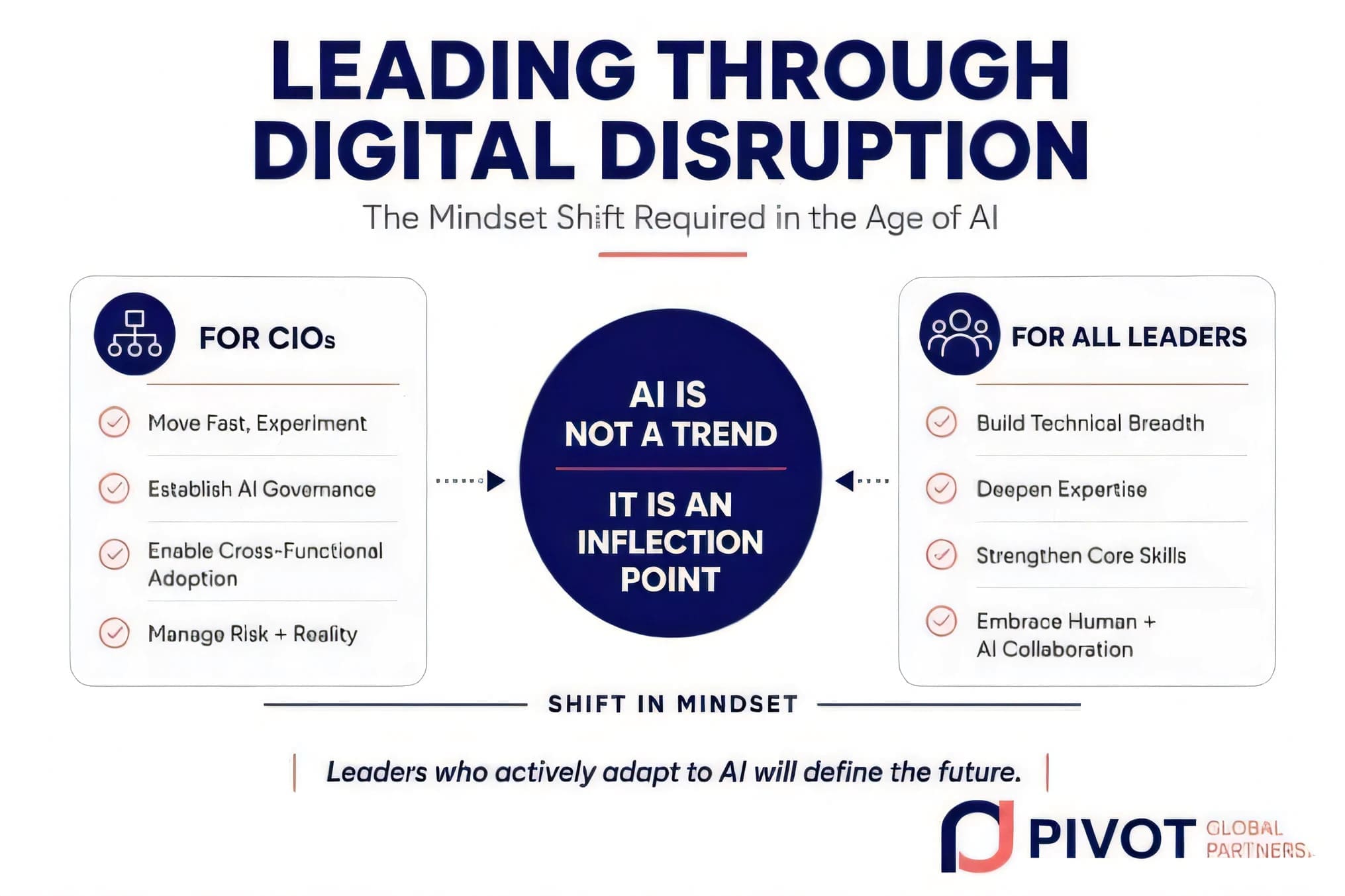
What are the key pivots to focus on if you are a CIO?
Get moving! Don’t dither on picking the best AI platform as it will likely keep shifting for quite some time (although if you work in government, you may have limitations in your choices). The proprietary platforms seem to have an advantage over Open Source currently. Very fast movers like Anthropic and OpenAI are adding to their solution set continuously. And it seems that switching platforms in the future may not be a huge, costly endeavor.
CIOs and other tech leaders can help organizations make this important pivot by continuous learning, speaking with many vendors, peers, and expert resources, being a thought leader, and remaining a calm voice of reason. Be open to new approaches, encourage others to adopt AI-based tools, set achievable expectations, and do purposeful experimentation. Look outside your own industry for inspiration and good ideas.
Institute cross-functional AI Governance that encourages experimentation and adoption while providing education, guidance, and guard rails. Accept that decision making will be imperfect but can be adjusted in the future. Decide which tools to block and which to allow, which business experiments get approval/funding, and what level of proprietary data can be exposed. Brainstorm and be prepared that some will try to undermine and bypass your best efforts. Manage and review vendors. Regularly review AI projects, collateral impacts, and unexpected consequences, both good and bad. And it is likely time to review your SaaS and internally developed solutions as targets for AI replacement.
Be a champion of an open but disciplined approach within your organization. Avoid emergence of “shadow IT.” Take a deeper role in vendor agreements across your entire enterprise, especially where they involve AI, proprietary data, and other technologies. Try AI prototyping and code generation tools while managing wild expectations. Help people understand why production-worthy solutions involve more than simply AI-generated code.
What about the rest of us?
For those who are not in traditional tech roles, here are some pivots to help better prepare yourselves and your teams for these changing times.
Technical Breadth. Many repeatable tasks and singular skills won’t survive so broadening ourselves is a good investment. It’s no longer acceptable to make technology the sole burden of the IT department. Everyone must improve technical competency. It only takes a few minutes to look up a new buzzword or read a few short articles on something we don’t understand.
Technology will remain a major factor in all areas, so stay abreast of it and get hands-on with it. At a minimum, try GenAI tools. Ask ChatGPT or Google Gemini or MS Copilot to help you write a thank you note, meeting agenda, or contract. At home, try “Create a 5-day itinerary for visiting Rome,” or “write a contract for landscaping my yard.” If you’re already doing all of this, partner with a member of your technology team to experiment with some AI brainstorming and coding tools (e.g., Anthropic Claude).
Depth of Expertise. We need expertise in multiple business, technical, and professional disciplines to increase our value beyond roles that AI or other technologies can easily supplant. It is important to be a trusted Subject Matter Expert. It’s not enough to know a lot. We must have relationships where our expertise is valued, appreciated, and invited.
Essential Skills. It’s still important to have fundamental skills that cut across industries and organizations. Here are some subsets:
- Core individual skills such as good communications, good interpersonal skills, and the ability to think creatively, deliver customer service, etc.
- Leadership skills such as the ability to make decisions, take calculated risks, delegate, and most importantly, deliver the right results.
- Change management skills are essential to survive and flourish in an environment where emerging technologies and rapid changes are the norm.
- Specialized skills that are learnable over time with continued exposure and guidance. For example, we need to know how to evaluate the results of AI tools and add value to decision making.
If you’re feeling overwhelmed, start with learning some basics…
- Generative AI, like ChatGPT, use Large Language Models (LLMs) to incorporate vast amounts of historical data, images, video, and even computer code. They are fantastic at quickly generating content as simple as a customized birthday greeting, to deep-fake images, and even realistic movie content such as the recent AI-generated fight scene between Tom Cruise and Brad Pitt. I use these tools like MS-Copilot or Google Gemini for a wide variety of tasks related to human language, like creating drafts, analyzing lengthy contracts, cleaning up documents, creating travel itineraries, etc.
- AI Agents perform designated, repetitive tasks using specific integrations and rules such as bots for customer service, travel, calendaring, and other helpful services.
- Agentic AI is for more dynamic multi-step tasks and workflows requiring complex conditions, reasoning, and adaptation. These probably feel the most threatening to people because they could displace higher level jobs like logistics management, research, project management, etc. When married together with Robotics and Smart Devices/Machines, these tools are even more powerful (e.g., autonomous vehicles, military drones, etc.).
As you acquire AI skills, use them to make you better as a leader. Integrate them into your research, strategizing, planning, and communications. Encourage your teams to use them to make creativity come alive, not just to drive efficiencies. And expand your decision making to consider the challenges, opportunities, and potential impact of human – AI collaborations.
The bottom line…
There is a global “arms race” to gain advantages via AI, so it is a reality. Those leaders who embrace and manage essential AI-related pivots are more likely to come out on top.